









Menu


Webflow vs Squarespacefor sites that need to grow
Squarespace gets a clean site live fast. Webflow gives a business room to build. We've put both in front of hundreds of teams, and here's how to tell which one your site needs.



Webflow or Squarespace

Best for solo creators
Squarespace is an all-in-one website builder designed to get a polished, template-based site live with no technical setup, which makes it a solid choice for solo creators and small local businesses.

Best for marketing teams
Webflow is a visual development platform with full design control, a structured CMS, and granular SEO tools, built for companies whose website works as a marketing channel. If the site has a team behind it and growth targets in front of it, Webflow is the stronger platform.
Webflow vs Squarespace
at a glance


Built around
Businesses running the site as a growth channel
Solo creators and small businesses
Design approach
Blank canvas, full visual control
Templates, customized within limits
CMS
Structured collections built for scale
Pages and blogs, simple by design
SEO
Full control over metadata, schema, redirects, sitemaps
Solid basics, less granular control
Integrations
Broad ecosystem plus custom code
Curated set, limited third-party tools
Commerce
Webflow Ecommerce or Shopify integration
Capable built-in commerce for small shops
Maintenance
Managed hosting, no plugins to babysit
Managed hosting, simplest to run
Best fit
B2B and marketing sites that change often
Portfolios, local businesses, simple sites
The five differences that decide it

Templates versus a blank canvas
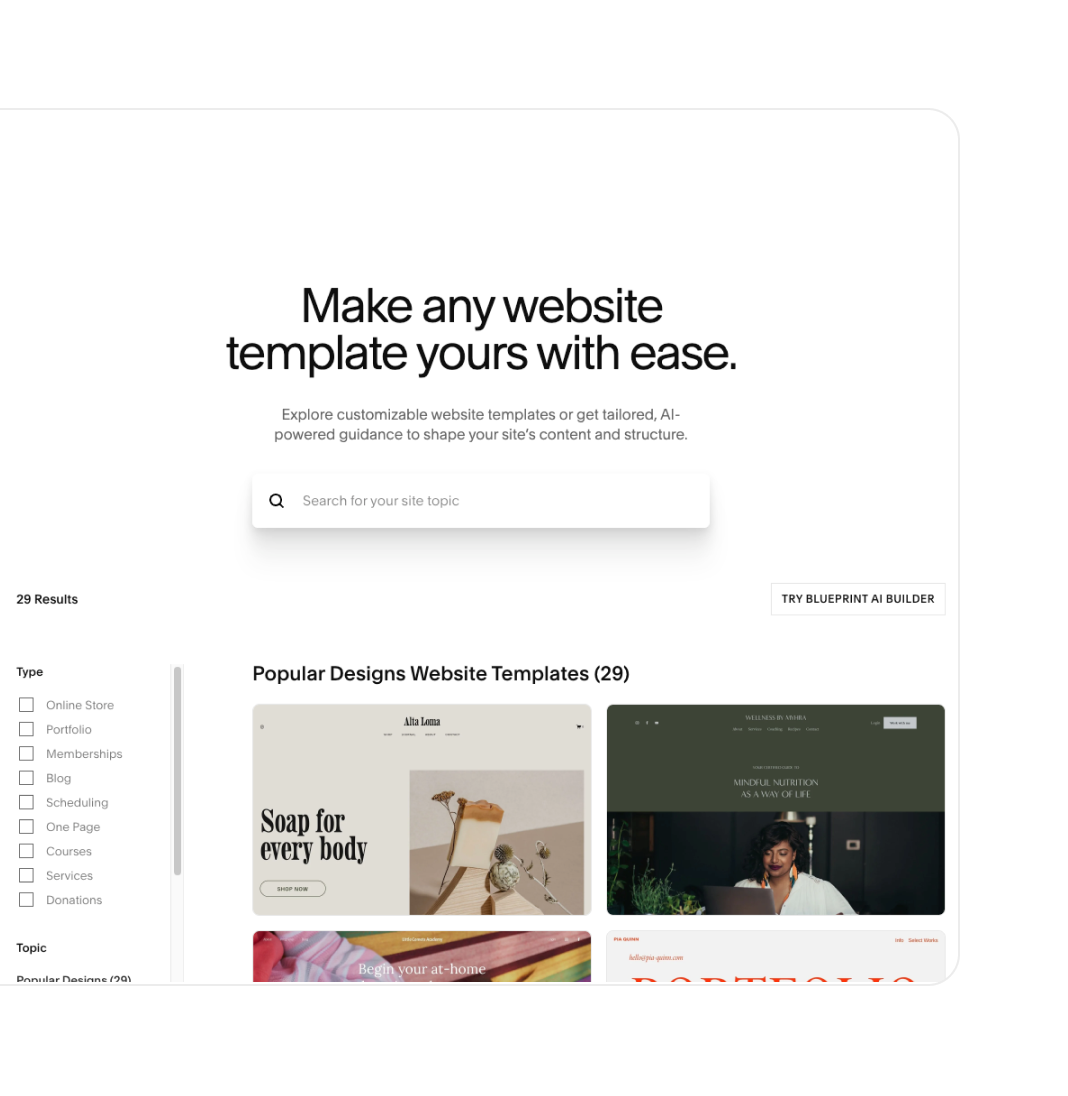
Templates are the heart of the difference. Squarespace starts you inside one, and everything you build lives within what that template allows. Webflow starts from a blank canvas with control over every class, breakpoint, and interaction. A Squarespace site looks like a well-executed template because it is one. A Webflow site looks like whatever your brand needs it to look like.

Who each platform expects you to be
Each platform has a clear picture of its user, and the picture decides the product. Squarespace expects one person (a photographer, a founder, a restaurant owner) doing everything, so it optimizes for simplicity over power. Webflow expects a team: a designer who wants control, a marketer who ships pages and campaigns, content editors working in a structured CMS. If "the team" is just you and will stay that way, that's a real signal, and it points to Squarespace.

Content at scale
A blog is where the gap starts to show. Squarespace handles posts and pages well, but that's roughly where its content model ends. Webflow's CMS is structured: collections, references, and custom fields that power resource hubs, case study libraries, integrations pages, and programmatic SEO. We've built Webflow CMS architectures running hundreds of items that a marketing team manages without touching a developer.

Room to run SEO
Search is where the ceiling shows first. Squarespace covers the basics (titles, descriptions, clean URLs) and that's enough for a local business. Webflow gives your team the full toolkit: schema markup, granular redirects, canonical control, and CMS-driven landing pages at scale. When organic traffic is a revenue channel rather than a nice-to-have, that control is the difference between running SEO and hoping for it.

What outgrowing looks like
Growing out of a platform is expensive, so it's worth predicting. The Squarespace ceiling appears as workarounds: content that doesn't fit the template, integrations the platform doesn't allow, SEO recommendations you can't implement. Webflow's ceiling is far higher: localization, enterprise hosting, custom code when you need it, and a component system your team extends instead of fighting. Pick the platform whose ceiling you won't hit.
When Squarespace is the right call
We build exclusively in Webflow, but for a real slice of the people searching this comparison, Squarespace is the honest answer. Squarespace is the better choice when:
- You're a solo creator, photographer, or local business and the site's job is to look good and share information.
- You want the simplest possible all-in-one: site, domain, commerce, and email in one subscription with nothing to manage.
- You need to be live this weekend and a quality template fits your brand fine.
- The site is small, will stay small, and nobody's running SEO campaigns on it.
If that's your situation, Squarespace will serve you well and you don't need an agency. When the site belongs to a business with a marketing team and a pipeline to feed, that's the job Webflow was built for, and that's where we come in.
Outgrowing Squarespace? Here's how the move works
The teams that come to us from Squarespace usually say the same thing: the site was perfect until the business grew around it. Moving to Webflow is a rebuild, and done right, it carries everything you've earned.

Audit and discovery
We review your Squarespace site, content, and traffic to map what's working, what's missing, and what the site needs to do next.

Architecture on Client-First
We design the Webflow class structure, CMS collections, and component system on Client-First, our open-source naming system used across the Webflow community, so the new site scales from day one.

Rebuild and content migration
We rebuild in Webflow with full design control and migrate your pages and blog into structured CMS collections, tested in staging.

Redirects, QA, and launch
Every URL gets a 301 redirect, metadata carries over, and we QA across breakpoints before the switch. Rankings and link equity stay intact.
Contact Sales
Why teams pick Finsweet
We're a 50+ person, full-time remote team. 500+ Webflow projects shipped since 2017, and we're a Webflow Enterprise Partner. Client-First and Attributes (our open-source JavaScript library for Webflow), used across the wider Webflow community, came out of our work. Teams hire us when the website stops being a brochure and starts being a growth channel.

Webflow vs Squarespace FAQ
Is Webflow better than Squarespace?
For businesses, usually yes: more design control, a structured CMS, and far deeper SEO tools. For solo creators and small local sites, Squarespace's simplicity often wins. The honest test is whether your website has a team behind it and growth targets in front of it.
What are the downsides of Squarespace?
The template is the ceiling: design lives within what it allows, third-party integrations are limited, and SEO control stops at the basics. None of that matters for a small site. All of it matters once a marketing team needs the site to perform.
Is Webflow harder to learn than Squarespace?
Yes. Squarespace is built so anyone can run it, and Webflow is built like a design tool, with a learning curve to match. That's a real cost if you're building the site yourself, and a non-issue if a team like ours builds it and hands your editors a structured CMS they can run without touching the design.
How do Webflow and Squarespace compare on cost?
Entry subscriptions are in the same neighborhood, and both include hosting. The bigger question is the cost of outgrowing the platform: a site that hits Squarespace's ceiling pays for a rebuild later. We'd rather scope the site around where the business is headed.
Can I move my site from Squarespace to Webflow?
Yes. We rebuild the site in Webflow, migrate your content into structured CMS collections, and set up 301 redirects so rankings carry through. Most teams use the move to fix information architecture at the same time.
Is Webflow better than Squarespace for SEO?
Webflow gives you substantially more control: schema markup, granular redirects, canonical tags, and CMS-driven pages at scale. Squarespace covers the fundamentals and is fine for a local business. For a company treating organic search as a channel, Webflow is the stronger platform.
Which is better for a portfolio site, Webflow or Squarespace?
Either works. Squarespace gets a beautiful portfolio live in a day, and for most creatives that's the right call. Designers who want custom interactions, unusual layouts, or a portfolio that doubles as a playground tend to pick Webflow.
Ready to talk through
your project?
Tell us about your site and what the business needs from it next. We'll give you a straight answer on which platform fits, and a clear scope if it's Webflow.